

Core Web Vitals are a set of three Google metrics — loading speed, interactivity, and visual stability — that quantify how a real user experiences your website. It's not a technical footnote; it's a proxy for revenue.
Sites that fail Core Web Vitals lose conversions before a visitor ever reads a headline, and no amount of ad spend fixes that leak.
The Problem: Marketing teams treat Core Web Vitals as an IT problem, not a revenue problem.
The Solution: Reframe CWV as a conversion-rate lever owned jointly by marketing and engineering
The Problem: Teams optimize for "passing" scores instead of real user impact
The Solution: Prioritize the metric tied to your actual drop-off point (LCP, INP, or CLS)
The Problem: No one measures the dollar cost of slow pages
The Solution: Tie CWV improvements directly to conversion and pipeline data
The Problem: Fixes are treated as one-time projects
The Solution: Build CWV monitoring into the always-on marketing ops stack
The catch 22 is that no matter how good your content is, if it takes too long to upload the article on a user's phone or desktop it decreases the chance for the user to interact with it and potentially purchase your product.
Core Web Vitals measures three things, and only three things: how fast your main content loads (Largest Contentful Paint, or LCP), how quickly your page responds to a click or tap (Interaction to Next Paint, or INP), and how much your layout jumps around while loading (Cumulative Layout Shift, or CLS). Google formalized these as part of its Page Experience signals, and they've been part of the ranking algorithm since 2021.
Here's the part most marketing decks get wrong: Core Web Vitals is not a proxy for "good design" or "good content." A beautifully designed page with a bloated JavaScript bundle can still fail badly. Conversely, a plain-looking page built on lean code can pass with ease.
This matters because it changes where the budget should go. If your team is spending on copywriters and creative to fix a "sluggish sales" problem that's actually a 4-second LCP, you're treating the symptom, not the disease.
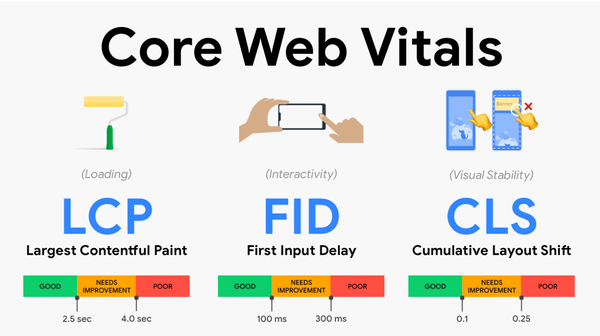
A "good" score means passing all three thresholds for the majority of real user visits: LCP under 2.5 seconds, INP under 200 milliseconds, and CLS under 0.1. Google reports this at the URL and origin level in Search Console, based on real Chrome user data rather than a lab simulation.
Yes, but as a tiebreaker, not a primary factor. Google has stated that Core Web Vitals is one of many Page Experience signals, and it carries more weight when competing pages have similar content quality and relevance. Strong content with poor CWV will usually still outrank thin content with perfect CWV.
Real-user CWV data updates on a rolling 28-day basis in Google's CrUX dataset, so monthly review is the practical minimum. High-traffic e-commerce or lead-gen sites should be monitored weekly, especially after any deployment that touches the homepage, product pages, or landing pages.
Yes. Google Ads Quality Score and Landing Page Experience both factor in load speed, which directly affects your cost-per-click. A slow landing page linked to a paid campaign inflates acquisition costs even when the ad itself is well-targeted.
Ownership works best as a shared function: marketing operations defines the business priority and revenue impact, while engineering or a technical SEO specialist executes the fix. Siloing it entirely in engineering is the most common reason CWV initiatives never ship.
Fixing Core Web Vitals isn't a single sprint — it's three separate diagnostic paths, one per metric. Treating them as one bucket of "site speed work" is why so many CWV projects stall out.
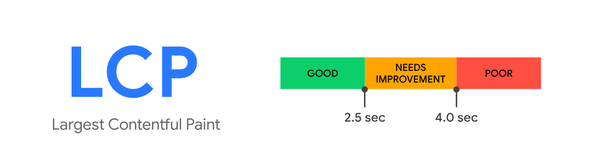
LCP measures how long it takes your largest visible element — usually a hero image or headline block — to render. Anything over 2.5 seconds is failing. The most common cause is an unoptimized hero image or a render-blocking script sitting above the fold. Fix this first, because LCP has the strongest documented correlation with bounce rate.
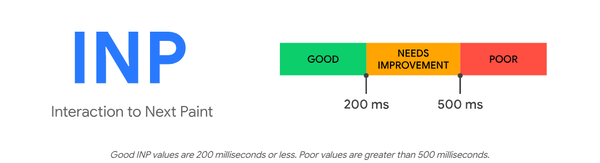
INP replaced First Input Delay in 2024 and measures the latency of every interaction on the page, not just the first one. A "good" score is under 200 milliseconds. INP failures are almost always caused by heavy third-party scripts — chat widgets, ad tags, and tracking pixels are the usual suspects.
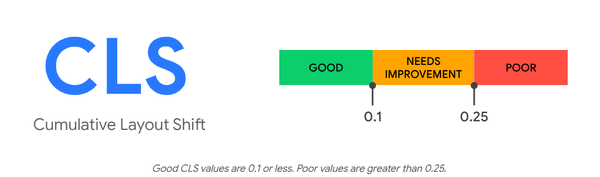
CLS measures unexpected movement of on-page elements — the classic "I went to tap a button and an ad loaded and I tapped the wrong thing" moment. A score under 0.1 is good. This is almost always fixed by reserving explicit width and height attributes for images, ads, and embeds before they load.
Core Web Vitals work dies in the backlog when it's filed as "nice to have" engineering debt. Marketing leaders need to attach a revenue number to the fix — projected conversion lift, projected organic traffic recovery — so it competes fairly against feature work.
CWV scores degrade silently every time a new script, plugin, or ad unit is added. A one-time fix without ongoing monitoring will regress within a few months, on average with tools like Lighthouse
LCP measures how long it takes your largest visible element — usually a hero image or headline block — to render. Anything over 2.5 seconds is failing. The most common cause is an unoptimized hero image or a render-blocking script sitting above the fold. Fix this first, because LCP has the strongest documented correlation with bounce rate.
INP replaced First Input Delay in 2024 and measures the latency of every interaction on the page, not just the first one. A "good" score is under 200 milliseconds. INP failures are almost always caused by heavy third-party scripts — chat widgets, ad tags, and tracking pixels are the usual suspects.
CLS measures unexpected movement of on-page elements — the classic "I went to tap a button and an ad loaded and I tapped the wrong thing" moment. A score under 0.1 is good. This is almost always fixed by reserving explicit width and height attributes for images, ads, and embeds before they load.
Core Web Vitals work dies in the backlog when it's filed as "nice to have" engineering debt. Marketing leaders need to attach a revenue number to the fix — projected conversion lift, projected organic traffic recovery — so it competes fairly against feature work.
CWV scores degrade silently every time a new script, plugin, or ad unit is added. A one-time fix without ongoing monitoring will regress within a few months, on average with tools like Lighthouse
Site speed data consistently shows a direct line between load time and conversion loss, which is why this stopped being a "developer conversation" years ago. Google's own research through its web.dev platform documents the relationship between Core Web Vitals thresholds and business outcomes across industries.
For an authoritative technical baseline, the W3C's Web Performance Working Group publishes the underlying specifications these metrics are built on, which is useful reading if your engineering team is pushing back on prioritization (w3.org).

Core Web Vitals are Google’s key measures for evaluating the real-world performance and usability of a website. They focus on three areas that directly influence the customer experience:
For marketing and product teams, the bigger issue is not simply whether a site "passes." Poor performance can create friction during critical customer journeys—such as landing on a campaign page, browsing products, completing a form, or making a purchase.
Core Web Vitals are a relatively lightweight component of Google’s ranking systems. They are not a substitute for strong content, relevance, authority, or search intent.
However, performance can become an important competitive factor when several websites offer similarly relevant and authoritative content.
More importantly for growth teams, the business impact extends beyond rankings. A slow or unstable experience can increase user frustration and abandonment, particularly on mobile and during high-intent conversion journeys.
That makes Core Web Vitals best viewed as part of a broader SEO, UX, conversion, and digital revenue strategy rather than simply an SEO technical score.
The difference comes down to simulated performance versus real-world performance.
Lab data, such as Lighthouse, tests your website under controlled conditions. It is extremely useful for developers and product teams because it helps identify specific performance problems before or after deployment.
Field data, primarily represented by the Chrome User Experience Report (CrUX), reflects how real users experience your website across different devices, browsers, networks, and locations.
For business and SEO decision-making, field data is particularly important because it shows what your actual audience experiences—not what the website looks like under ideal testing conditions.
Desktop and mobile users can have dramatically different experiences.
Mobile devices generally have less processing power, users may rely on slower or less stable connections, and mobile pages can be affected by large images, third-party scripts, advertising technology, analytics, and other resources competing for bandwidth and processing capacity.
This matters because mobile is often where a significant portion of organic traffic and customer journeys occur.
If your site performs well for desktop users but poorly for mobile users, the priority should not simply be achieving a better technical score. The goal should be identifying whether performance problems are affecting organic visibility, engagement, lead generation, ecommerce conversion, or other key business outcomes.
Core Web Vitals are based on real-world user data collected over a rolling 28-day period. This means improvements are not necessarily reflected immediately after a technical fix is deployed.
When you request "Validate Fix" in Google Search Console, Google needs sufficient real-user data to determine whether the affected URLs are consistently meeting the required thresholds.
For marketing and product teams, this means Core Web Vitals should be managed as an ongoing performance KPI, not as a one-time technical project.
A better approach is to establish a baseline, identify the pages and user journeys that matter most commercially, implement improvements, and monitor the resulting field data over time.
The most successful teams don't treat Core Web Vitals as a one-time technical audit. They treat website performance as ongoing digital infrastructure.
Once a stronger performance baseline is established, every new landing page, product page, campaign, and content initiative can benefit from it. Over time, this creates compounding improvements in user experience, SEO performance, and conversion opportunities.
For CMOs and growth leaders, the strategic value is therefore bigger than fixing today's performance issues. The goal is to build a faster, more resilient digital foundation that supports future marketing and revenue growth.
In other words, Core Web Vitals shouldn't be viewed as a project with an end date. They should be managed as an ongoing performance standard across the digital organization.

Marc A. Theodore is an AI Optimization specialist and the SEO / GEO Director at Numerique.ca, a Boutique bilingual CRM development agency based in Quebec. As the former Head of SEO at Bell Media, Marc helps businesses with large electronic footprints navigate the complexities of the Canadian web ecosystem. He focuses on bridging the gap between traditional organic growth and the emerging demands of Generative Engine Optimization (GEO), ensuring that established enterprises stay visible, agile, and authoritative in an AI-driven search landscape.
https://x.com/marc_a_theodore
https://www.linkedin.com/in/marc-a-theodore/

Avec mon expérience en consultation SEO, j'aide les entreprises SaaS, technologiques, logicielles et TI à développer leur pipeline de ventes et leurs revenus grâce à des stratégies SEO axées sur la performance et la visibilité dans les recherches alimentées par l'IA.


SEO services
SEO compétences
SEO industries
SEO référencement
SEO blogue
À propos
Étude de cas
Glossaire
Nous joindre
Confidentialité

Notre bulletin SEO
Soyez toujours bien informé! Ne manquer rien des derniers développements dans le monde du SEO!

Des clients satisfaits